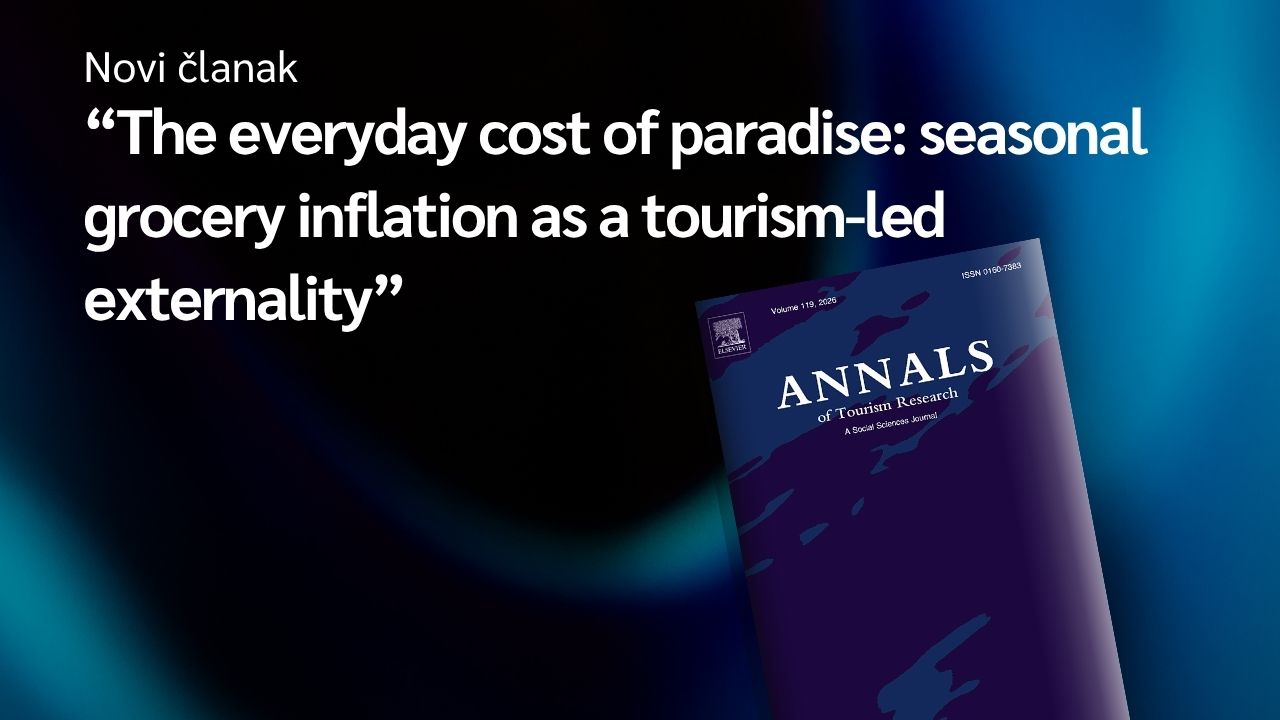
The paper titled “The everyday cost of paradise: seasonal grocery inflation as a tourism-led externality” has been accepted for publication in the world’s leading tourism journal, Annals of Tourism Research (AJG = 4, WoS Q1, Scopus Q1).
The authors of the paper are Zvonimir Kuliš, project lead and Assistant Professor at the Department of Tourism, Faculty of Economics, University of Split; Josip Mikulić, Full Professor at the Department of Tourism, Faculty of Economics, University of Zagreb, and Scientific Advisor at the Institute for Tourism; and Stjepan Srhoj, Associate Professor at the Department of General Economics, Faculty of Economics, University of Split, and Senior Research Associate at Institute for Development and International Relations (IRMO).
Since May 2025, retail traders in Croatia have been legally required to publish their product prices publicly on a daily basis. This dataset—comprising approximately 1.3 billion daily price records for the period from May to October 2025—enabled the authors to track price movements of individual products across locations and compare coastal municipalities with the rest of Croatia throughout the entire tourist season.
Prices in coastal, tourism-intensive municipalities are already higher in May, but the paper’s main finding is that they increase further during the summer. This additional increase follows an inverted U-shaped pattern: the difference in price growth between the coast and inland areas gradually widens as the season progresses, peaks in July and August when tourism demand is at its highest, and then weakens by October. This pattern remains robust even when the analysis is restricted to a subsample of 30 essential product categories and a subsample of products with identical barcodes. The analysis also finds that the average price increase on the coast is greater for one group of retail chains, while for others, prices on the coast and inland change at roughly the same rate on average.
The results suggest that seasonal grocery price inflation represents a tourism externality that directly affects local residents. This also raises questions of fairness: coastal cities are home to many residents who do not earn income from tourism, yet they are effectively disadvantaged by seasonal price increases, as the real value of their wages falls below that of workers in other parts of Croatia. This is particularly pronounced in occupations with nationally standardized wages, such as healthcare workers, teachers, and police officers.
As a direction for future research, the authors propose comparing the two sides of household budgets in coastal areas: on the one hand, how much higher residents’ expenses are due to the increased cost of living, and on the other, whether their incomes are also higher because tourism creates additional earning opportunities. It is almost certain that some households benefit while others lose out, making this the key relationship to measure in order to determine who ultimately profits from tourism and who bears its cost.
More details are available in the article: https://doi.org/10.1016/j.annals.2026.104225
The open-access version of the article is available at: https://ideas.repec.org/p/zbw/glodps/1774.html