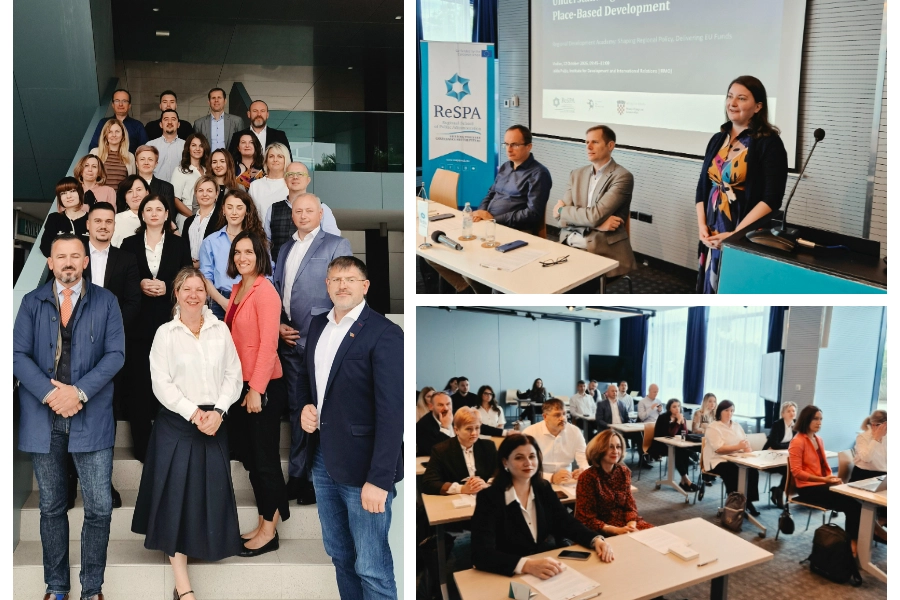
Dr Jakša Puljiz, Director of the Institute for Development and International Relations (IRMO), participated as a lecturer in the international Regional Development Academy, held from 11 to 17 October 2026 in Vodice and Šibenik-Knin County, Croatia. The Academy was jointly organised by the Regional School of Public Administration (ReSPA) and the Ministry of Foreign and European Affairs of the Republic of Croatia, bringing together representatives of public administrations from the Western Balkans, Moldova and Ukraine.
The programme, entitled Shaping Regional Policy, Delivering EU Funds, focused on strengthening institutional capacities for strategic planning of regional and local development, EU funds programming and the implementation of development investments. Particular emphasis was placed on sharing knowledge and experience relevant to preparing EU candidate countries for future membership.
Jakša Puljiz delivered a series of lectures on the evolution and functioning of EU cohesion policy, territorial approaches to development, and proposed changes under the EU’s new Multiannual Financial Framework for 2028–2034. He also presented Croatia’s regional development policy framework, including support instruments for less-developed areas, integrated territorial investments and the role of regional development coordinators. His lectures on strategic planning highlighted the importance of linking development priorities to funding sources, preparing high-quality project pipelines and ensuring effective coordination across different levels of government.
The lectures and discussions also addressed the broader development benefits of cohesion policy, including the strengthening of institutional capacities and public investment, alongside challenges related to implementation effectiveness and the achievement of long-term development impacts.
The Academy combined expert lectures, interactive workshops and group activities with study visits to Šibenik and the islands of Zlarin and Prvić. Participants explored examples of investments in cultural heritage, sustainable tourism and local infrastructure, while gaining insights into the work of Šibenik-Knin County and its regional development agency in preparing and implementing EU-funded projects.
Through its participation in the Regional Development Academy, IRMO contributed to the international exchange of knowledge and experience in cohesion policy, regional development and European integration, while strengthening cooperation with institutions from EU candidate countries.
More information:
Photo: ReSPA